
- By Phoenix Roofing and Solar
- Uncategorized
- 0 Comment
A roof pipe boot is the flashing assembly that seals around plumbing vent pipes where they exit through your roof. When that seal fails, water enters. In Elyria, OH, failed pipe boots rank among the most frequent causes of roof leaks, and homeowners often mistake them for bigger, more expensive problems than they actually are.
This guide covers how pipe boots work, why they fail, what to look for, and how roofers fix them.
Key Takeaways
A roof pipe boot seals the gap between a plumbing vent pipe and your roof surface. Flashing failures are a leading cause of roof leaks, and cracked or degraded pipe boots are one of the most common flashing problems in Elyria, Ohio.
Most roof pipe boot leaks can be fixed as localized roof repairs, not full roof replacements, when surrounding shingles and decking are still in serviceable condition.
Warning signs include ceiling stains near bathrooms, damp insulation in the attic around vent pipes, visible cracks in the rubber collar, and leaks that appear during heavy rain or snowmelt.
Pipe boot leaks require prompt repair to prevent interior damage. Worn pipe boots can lead to rotted decking, ruined insulation, and rising energy costs if left alone.
If you suspect a roof pipe boot leak in Elyria, Ohio, schedule a free roof inspection today. A professional can confirm the source, check surrounding components, and recommend the right leak repair before the problem spreads.
What Is a Roof Pipe Boot?
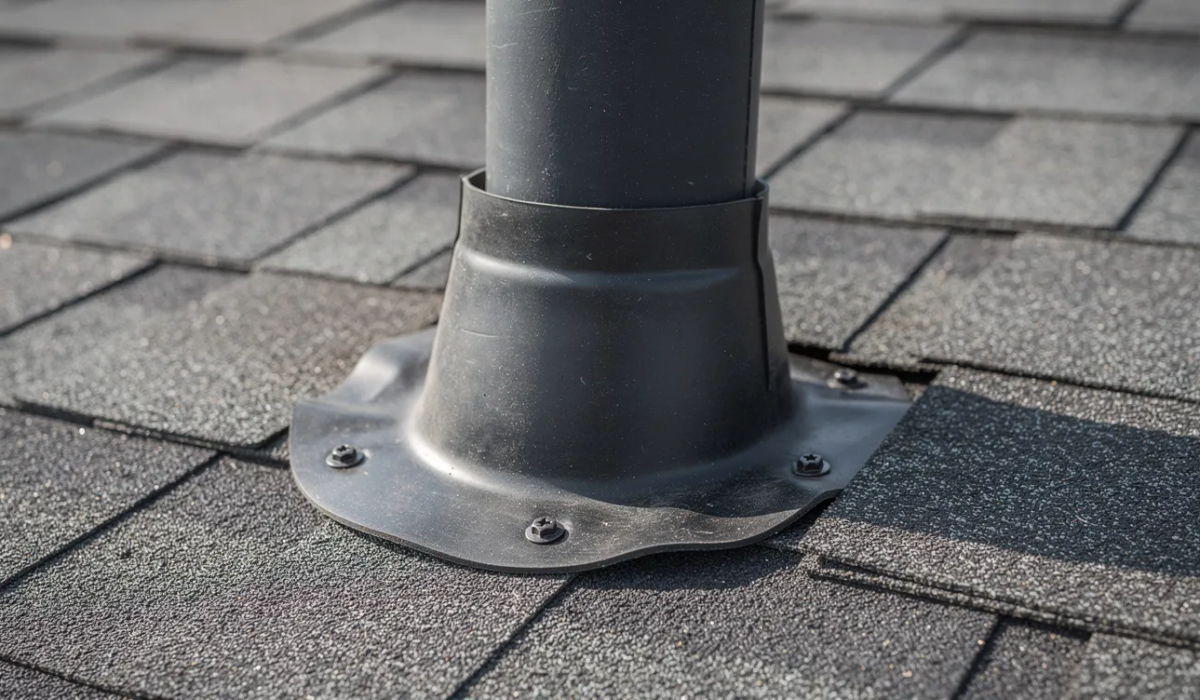
A roof pipe boot is the waterproof seal around plumbing vent stacks that pass through your roof. It combines a flat metal or plastic base with a flexible rubber collar that wraps tightly around the pipe, directing water onto the shingles below instead of letting it run down the pipe and into your house.
Here is how the components work together:
The base plate (aluminum, galvanized steel, or molded plastic) sits flat against the roof deck and slides under the shingles on the uphill side.
The rubber or neoprene collar grips the pipe and forms the primary water barrier at the penetration point.
Shingles overlap the base on the uphill and side edges, creating a layered water-shedding path.
On a typical Elyria home, you will find pipe boots around 2- to 4-inch PVC plumbing vents serving bathrooms, kitchens, and laundry rooms. Pipe boots are prone to wear and leaks, which is why they are one of the most common small components local roofers replace during leak repair service calls.
Why Are Plumbing Pipes Venting Through My Roof?
Plumbing vents serve two purposes: they let sewer gases escape safely outside your house, and they equalize air pressure inside drain lines so sinks, toilets, and tubs drain properly.
Vent pipes must exit above the roofline so gases do not collect inside walls or attics.
Both older and newer homes in Elyria have PVC or cast-iron vents that run vertically through the roof. This is standard residential construction.
Each plumbing vent creates a roof penetration that needs its own pipe flashing to stay watertight.
Other penetrations (furnace exhausts, fan vents) require different flashing types, which is why accurate leak diagnosis matters before any repair work starts.
Having multiple pipes through the roof is normal. The pipes themselves are not the problem; the seals around them are what fail.
What Does a Roof Pipe Boot Look Like?
From the ground, a pipe boot looks like a short vertical pipe sticking up from the roof with a cone-shaped rubber collar and a flat base at the shingle surface. You can often spot them with binoculars.
Rubber collars: A dark rubber or neoprene ring that hugs the vent pipe. These are the parts that crack, split, or pull away as they age. Once the collar loses its grip, water runs right down the pipe and into the attic.
Metal bases: Aluminum or galvanized steel plates integrated with shingles to shed water. The flashing base of a pipe boot can rust or develop holes over time, especially in Ohio’s wet climate.
Plastic components: Some newer boots use molded plastic bases. These can become brittle in Northeast Ohio’s cold winters.
Combination assemblies: Boots with a metal base, rubber collar, and protective cap. Professional roofing contractors in Elyria commonly install these on new roofs or during replacements.
If the collar no longer sits tight against the pipe, or you see gaps, gray discoloration, or splitting, those are signs of a cracked pipe boot that needs attention.
Why Do Roof Pipe Boots Fail?
In Elyria and across Lorain County, pipe boot leaks usually result from a combination of weather, age, and installation quality. Common causes of roof pipe boot leaks include freeze-thaw cycles and UV degradation, but the full list runs deeper.
Rubber deterioration: The neoprene or EPDM collar dries out over time. Brittle rubber collars can develop cracks before shingles show any wear at all.
UV exposure: Years of direct sunlight break down the rubber’s molecular structure. South-facing boots degrade faster.
Temperature swings: The rubber collar of traditional pipe boots is susceptible to cracking from temperature changes. Elyria regularly swings from below-zero winter nights to 90°F summer days.
Age: Pipe boots generally last 10 to 15 years before degrading, often half the lifespan of the shingles around them.
Improper installation: Improper installation of pipe boots can allow water to enter around the flashing from day one, whether due to incorrect shingle overlap, missing underlayment, or a mismatched collar size.
Fastener issues: Nails or screws can back out, rust, or lose their seal, creating small entry points for water.
Pipe movement: Thermal expansion and house settling can shift the vent pipe slightly, breaking the collar’s seal.
Storm damage: High winds, hail, and flying debris crack plastic covers, dent metal bases, and tear rubber collars.
Surrounding shingle damage: Broken or lifted shingles near the boot break the water-shedding path, funneling water toward the penetration.
Poor previous repairs: Layers of caulk smeared over a failing collar may hold for a season, then let go; leaving the original problem plus a mess of dried sealant on top of it.
Debris accumulation can also create dams around pipe boots, trapping moisture against a compromised seal. Flashing failures are a leading cause of roof leaks, and the pipe boot collar is the weakest link in the chain.
Signs Your Roof Pipe Boot May Be Leaking
Pipe boot problems tend to show up first as subtle interior symptoms rather than obvious roof damage. Signs of a pipe boot leak include water stains on ceilings and damp insulation in attics.
Ceiling stains: Brown or yellow marks near bathrooms or hallways, especially after heavy rain. In many Elyria homes, the first clue is a small spot on the second-floor ceiling near a bathroom vent stack.
Attic moisture: Darkened plywood or wet insulation around the vent pipe when you look in the attic with a flashlight.
Damp decking: Soft or discolored roof sheathing near the pipe penetration.
Cracked rubber: Visible cracks in the rubber collar of a pipe boot indicate deterioration and almost always mean water is getting through.
Visible separation: Gaps between the collar and the pipe, or between the base and the shingles.
Shingle problems near the vent: Curling edges, nail pops, or lifted shingles that expose the boot’s base.
Leaks during rain or snowmelt: Water that appears on interior walls or ceilings when the roof is wet and stops when it dries.
Active leaks require immediate attention to prevent damage to insulation, drywall, and framing. Don’t wait for the stain to grow. Emergency repairs can prevent insulation and drywall damage if you catch the problem before water spreads through framing cavities. A roof inspection in Elyria can confirm whether the vent boots, flashing, or shingles are the source.
Plumbing Vent vs. Bathroom Exhaust Vent
Homeowners often confuse plumbing vents with bathroom exhaust vents. They look different, serve different purposes, and fail differently.
Detail | Plumbing Vent | Bathroom Exhaust Vent |
|---|---|---|
Function | Releases sewer gas; equalizes drain pressure | Removes humid air from bathroom |
Pipe size/material | 2–4 in. PVC or cast iron | 4–6 in. metal duct |
Runs from | Drain-waste-vent system | Bathroom ceiling fan |
Roof flashing type | Pipe boot with rubber collar | Metal hood with damper flap |
Common leak symptoms | Water running down pipe into attic; stain near pipe | Water pooling at hood seam; staining around duct |
Repair approach | Pipe boot replacement or collar repair | Hood replacement, re-flashing, or duct correction |
Correctly identifying which penetration is leaking is critical before ordering a pipe boot replacement or any other roof repair. A roofer who checks both during the same visit saves you a callback.
Why Is My Roof Leaking Near the Bathroom?
Many leak calls in Elyria start with the same complaint: “My ceiling is wet right outside the bathroom.” Several roof-related causes could explain it.
A failing plumbing vent boot letting water run down the pipe
A leaking bathroom exhaust vent hood where the flashing has separated
Condensation from an uninsulated or disconnected exhaust duct venting warm, moist air into the attic
Nearby flashing problems at a wall-to-roof junction or valley
Damaged shingles upslope of the bathroom, funneling water toward a penetration
Water traveling along framing from a leak several feet away before dripping near the bathroom ceiling
Flashing failures are a leading cause of roof leaks, and the bathroom area of a house has the highest concentration of roof penetrations. A professional roofer in Elyria will check all penetrations and nearby details on the slope before recommending a fix. Skip the urge to cut open drywall hunting for the source; arrange a free roof inspection to locate the problem from the exterior first.
How Roofers Find a Pipe Boot Leak
Diagnosing a pipe boot leak involves both exterior and interior investigation. Guessing based on the stain location alone usually leads to the wrong repair.
Exterior inspection:
Check the rubber collar for cracks, gaps, or hardening
Examine the metal base for rust, bends, or lifted edges
Verify that all fasteners are secure and properly covered
Evaluate surrounding shingles for damage or incorrect overlap
Attic inspection:
Look for darkened plywood or OSB around the vent penetration
Check insulation for dampness or compression near the pipe
Map the direction of any water trails or staining along framing and decking
Experienced guys doing roof inspections in Elyria may run a controlled water test if the leak is intermittent. They hose specific roof areas one at a time while someone watches from the attic. The interior stain is often several feet from the actual boot, so pattern recognition and attic access are essential.
Can Water From a Pipe Boot Leak Travel?
Water from a leaking pipe boot can absolutely travel before it shows up on your ceiling. This misleads homeowners about the true source of the leak all the time.
Water runs along the underside of roof decking, following the slope until it hits a seam, nail, or low point.
Water can travel along rafters, trusses, pipes, or electrical wires before dripping down.
Nails and fasteners act as drip points; a ceiling stain may line up with a row of nails rather than the boot itself.
On multi-slope roofs common in Elyria neighborhoods, water can cross from one framing bay to another before showing up inside.
This is why professional leak repair in Elyria always starts on the roof and in the attic, not at the visible interior stain.
Can a Leaking Pipe Boot Rot Roof Decking?
Yes. A long-term roof pipe boot leak can rot the decking if moisture soaks the plywood or OSB repeatedly. Worn pipe boots can lead to water damage that compounds over time.
Early signs:
Moisture staining around the vent pipe visible from the attic
Slight waviness in the roof plane near the vent
Minor softness in the sheathing when probed by a professional
Advanced problems:
Delamination of plywood layers
Spongy or soft spots underfoot
Fasteners that pull free because the wood fibers have broken down
Water damage from leaks can also lead to rising energy costs, because wet insulation loses its thermal resistance and your HVAC system has to work harder to compensate. If you notice any of these signs, a thorough inspection near all known or suspected leaks is the right next step. For more detail on how roofers evaluate and replace damaged sheathing, see a resource on roof decking in Elyria.
Does Stained Plywood Mean It Needs Replacement?
Stained plywood or OSB in the attic does not always need to be torn out. The deciding factor is structural condition, not appearance.
Some stains are from old leaks that were already fixed. If the wood is dry, hard, and still holds fasteners firmly, it may just need monitoring.
Roofers check for softness, crumbling, delamination, or fungal growth before recommending removal.
Minor, dry staining near a plumbing vent may only require watching after the pipe boot replacement is done.
In Elyria and Lorain County, many attic inspections reveal cosmetic staining without structural damage. Replacement is not automatically the call.
Can a Roof Pipe Boot Be Replaced Without Replacing the Entire Roof?
Yes. In many Elyria homes, a failed pipe boot can be addressed as a localized roof repair without replacing the entire roofing system.
As long as the surrounding shingles are still flexible, properly granulated, and reasonably well attached, a roofer can remove a limited number of shingles, swap out the boot, and re-integrate everything. Common repair options for leaking pipe boots include full boot replacement or, in some cases, a collar-only repair with an overlay product when the base is still sound.
This is a routine job for roofs that are otherwise in good condition but have one or two aging boots. The roofer will match shingle color and style as closely as possible, though slight shade differences may show on older roofs.
A failed pipe boot alone does not mean the roof is bad. But the roofer should still assess overall roof condition during the visit to catch any other emerging issues.
How Roofers Replace a Failed Pipe Boot
Here is the general process a roofing company in Elyria, Ohio follows for pipe boot replacement on an asphalt shingle roof:
Confirm the boot is the leak source through exterior and attic inspection.
Carefully lift or remove surrounding shingles above and beside the boot.
Extract the old boot and any compromised underlayment.
Inspect the underlying roof decking for moisture damage.
Repair or replace small sections of damaged decking if needed.
Install new underlayment around the penetration.
Fit and fasten the new pipe flashing assembly with the collar snug to the pipe.
Weave the flashing properly with shingles above and below; the upslope shingles overlap the top edge of the base, and the base overlaps the downslope shingles.
Seal fastener heads with compatible roofing sealant.
Check the repair from both the roof and the attic.
Proper flashing prevents water damage and rising energy costs by keeping the building envelope intact. On many Elyria homes, this type of Lorain County roof repair can be completed in a single day, weather permitting. Quality materials, such as UV-resistant rubber collars or specialty boots, extend the life of the repair in harsh conditions.
Why Simply Adding Caulk May Not Solve the Problem
Caulk and roofing sealant have legitimate uses, but smearing sealant over a failing boot usually masks the symptom instead of correcting the cause.
Common scenarios where caulk falls short:
A homeowner or handyman applies a thick bead of sealant around a cracked rubber collar. The sealant hides the crack but does not restore the collar’s elasticity. After a few freeze-thaw cycles, the sealant itself cracks and the leak returns.
Sealant is layered over exposed nail heads without addressing the fact that the metal base has lifted or rusted through.
Sealant shrinks, hardens, and eventually lets go under Elyria’s seasonal punishment. Professionals may still use compatible sealant as a finishing detail (on fasteners, under a flashing edge), but they do not rely on it as the entire fix. If the collar or base has failed, the boot needs replacement, not more crap piled on top of a broken seal.
Pipe Boot Leak vs. Attic Condensation
Moisture in the attic is not always from a roof pipe boot leak. Condensation from poor ventilation can produce similar-looking stains.
Boot leaks worsen during rain or snowmelt and follow gravity from a specific penetration point. You will see focused wet spots or trails near the vent pipe.
Condensation tends to appear during cold weather and shows as widespread frost on nail tips, damp insulation across broad areas, or general mustiness. It often signals inadequate attic ventilation or bath fans venting into the attic instead of outside.
Proper attic ventilation and correctly ducted exhaust fans help rule out condensation as the moisture source during Elyria’s cold winters. When there is any doubt, a professional evaluation distinguishes between a localized roof penetration leak and a broader ventilation problem.
How Northeast Ohio and Elyria, OH Weather Affect Roof Pipe Boots
Roof components in Elyria face severe stress due to harsh seasonal shifts. Northeast Ohio experiences conditions that frequently lead to pipe boot deterioration.
Summer heat and UV: Attic temperatures can push past 120°F. That heat, combined with direct sun, dries and cracks rubber collars faster than in milder climates.
Winter cold, snow, and ice: Elyria roofs face leaks from heavy snowfall and wind storms. Standing snow around a vent pipe holds moisture against a compromised boot for days, increasing intrusion during late-winter melts.
Freeze-thaw cycles: Water that seeps into a hairline crack expands when it freezes, widening the gap. Each cycle makes the opening larger.
Seasonal expansion and contraction: The roof deck, shingles, and vent pipes expand and contract at different rates, straining the boot and its fasteners.
Winter-capable repairs stop leaks even in freezing temperatures, so homeowners should not assume they have to wait until spring to address a problem discovered mid-January. Periodic checks of all roof penetrations are important for any Northeast Ohio roofing system, even one that is not yet at the end of its expected life.
Does a Pipe Boot Leak Mean I Need a New Roof?
No. A leaking pipe boot alone usually does not mean you need a full roof replacement.
Many otherwise healthy roofs develop isolated issues at penetrations that a focused leak repair visit can solve. Prompt roof repair extends system lifespan and protects interiors without the cost of tearing everything off and starting over.
Roofers may start discussing broader replacement when:
Shingles are brittle, heavily granule-worn, or curling across large areas
Multiple leak points exist on different slopes
Underlying decking shows widespread deterioration
A reputable roofing company in Elyria will inspect the entire roof, take photos, and explain options before recommending a full replacement. The goal is to extend the life of a repairable roof with targeted fixes when that approach still makes sense.
Pipe Boot Leak Repair vs. Roof Replacement
Homeowners often want a clear comparison. Here is a general framework:
Factor | Pipe Boot Repair / Localized Roof Repairs | Broader Roof Work / Replacement |
|---|---|---|
Number of failed boots | One or two | Multiple, across different slopes |
Surrounding shingles | Flexible, granulated, reasonably attached | Brittle, curling, widespread granule loss |
Damage scope | Localized near one or two penetrations | Spread across large areas |
Decking condition | Sound or minor staining only | Soft, delaminated, or widely deteriorated |
Roof age/condition | Still within a repairable range | Past the point of reasonable repair |
Typical cost range (Ohio) | $150–$800 per penetration | Five figures for most homes |
Reflashing during a re-roof costs less than doing it separately, so if the roof is already due for replacement, combining the work saves money. But for many Elyria homes with roofs under 20 years old and maintained shingles, a pipe boot leak sits firmly in the repair column.
Use a professional roof inspection to determine which side of the table your roof fits. A roofer can give you a quote and walk you through the detail behind the recommendation.
Other Roof Penetrations That Can Cause Leaks and Require Roof Repairs
Plumbing vent boots are common leak sources, but they are not the only penetrations Elyria homeowners should care about.
Bathroom exhaust vents: Metal hoods with damper flaps; seams and under-flashing can fail.
Kitchen exhaust vents: Similar hood design; grease buildup can accelerate corrosion.
Box vents and ridge vents: Provide attic ventilation; fastener failure or improper shingle integration creates openings.
Skylights: Surrounded by step flashing and head flashing that can pull away from the frame. Step flashing must be woven into the courses of shingles to shed water correctly.
Chimneys: Use counter flashing, step flashing, and often a cricket. A cricket is required for chimneys wider than 30 inches to divert water around the upslope side.
Comprehensive roof repairs typically include checking all penetrations on a slope once a leak is found at any single point. A problem at one vent does not mean every vent is failing, but it is worth looking while the roofer is up there.
Should Pipe Boots Be Inspected After Storm Damage?
After high winds, hail, or heavy wind-driven rain in Elyria, pipe boots and all flashing points should be part of a broader roof inspection.
Storm-related risks to pipe boots:
Lifted or displaced shingles near the vent that expose the boot’s base
Wind-driven debris cracking plastic covers or denting metal bases
Hail splits in rubber collars or metal flanges
Sealant joints opened by movement or impact
Roof repair services include storm damage assessments and repairs. Emergency roof repair services prevent further interior damage when a storm opens a gap that lets water flow fast into the attic. Some insurance-covered storm damage claims in Lorain County start with small issues at penetrations that grow when left unaddressed. Your insurance policy may cover sudden damage from wind or hail, while gradual wear typically is not covered. Documenting damage with photos and noting the storm date strengthens a potential claim.
If you are in Elyria, Lorain, North Ridgeville, Amherst, Sheffield, Sheffield Lake, Avon, Avon Lake, or Grafton and suspect storm-related damage, schedule a free roof inspection. Don’t hold off until the ceiling stain is the size of a dinner plate. The sooner a roofer evaluates the roof, the more options you have to protect the structure and finish the repair before secondary damage sets in.
Whether you need a single boot swapped out or a full damage assessment after a storm, the right approach starts with getting someone qualified on the roof. Look for a licensed, insured roofer (whether they operate as an LLC or another structure) with experience in Northeast Ohio roofing conditions. The guys who know this climate understand what to look for and how to make a repair that holds.
Frequently Asked Questions
How long does a roof pipe boot usually last in Elyria, Ohio?
Many standard rubber pipe boots last roughly 10 to 15 years in Northeast Ohio conditions, though lifespan varies with material quality, roof orientation, and weather exposure. Homeowners should start having boots closely inspected once the roof passes the 8- to 10-year mark, or sooner after a major storm.
Can I install a pipe boot cover instead of replacing the boot?
Aftermarket pipe boot covers (like Perma-Boot or similar slide-over products) can sometimes extend a boot’s functional life when the existing metal base is still sound but the collar is cracking. A professional roofer should confirm that a cover is appropriate for your specific pipe size, roof pitch, and exposure before relying on it as a long-term fix.
Is a roof pipe boot leak covered by homeowners insurance?
Coverage typically depends on the cause. Sudden storm damage may be covered, while gradual wear, aging rubber, or maintenance neglect usually is not. Review your policy, talk with your insurance agent, and ask your roofer to document any storm-related damage with photos and dates to support a potential claim.
How many plumbing vent boots does a typical Elyria home have?
Most single-family homes in Elyria have between one and four plumbing vent boots, depending on the number of bathrooms, kitchens, and the plumbing layout. During any roof inspection, all visible vent boots should be evaluated, not just the one closest to an active leak.
Can I walk on the roof myself to check the pipe boots?
Most homeowners should avoid walking on their roof. Fall risk is real, steep pitches are common, and foot traffic on aged shingles can cause additional damage, especially in wet or icy conditions. Use binoculars from the ground, check from the attic, or have a roofer in Elyria, Ohio take photos during a professional inspection. It is the safest and most accurate way to assess boot condition without making anything worse.